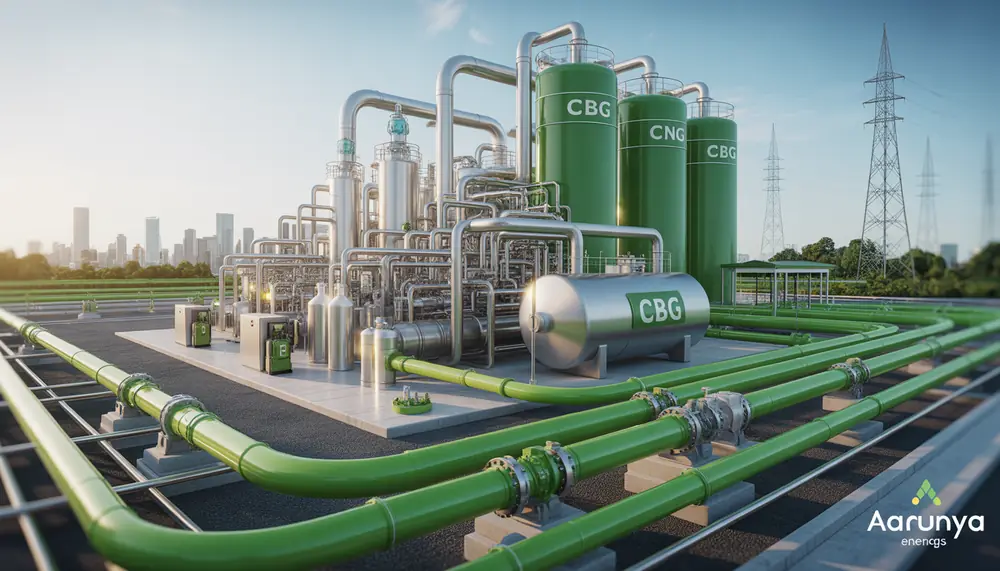
India has taken a major step toward strengthening its energy security by expanding the Compressed Biogas (CBG)–City Gas Distribution (CGD) synchronisation scheme until 2047. A key update in the revised policy is the permission for direct injection of CBG into the national gas pipeline network, marking a significant shift in India's clean energy strategy.
The scheme, initially launched in 2021, aimed to promote the production and distribution of compressed biogas across city gas networks. With the revised guidelines introduced in August 2025, the government has now enabled CBG producers to inject gas directly into pipelines. This eliminates the need for physical transportation through cylinders or tankers, making the system more efficient and cost-effective.
This policy shift comes at a crucial time when India is facing increasing pressure on liquefied natural gas (LNG) imports. A large share of LNG imports is sourced from regions that are often affected by geopolitical uncertainties. Such dependence exposes the country to supply disruptions and price volatility. By promoting domestically produced CBG, the government aims to reduce reliance on imported fuels and create a more stable energy ecosystem.
Allowing pipeline injection of CBG brings multiple advantages. It significantly reduces logistics costs by removing the need for road-based transport. It also ensures seamless distribution across regions, improving accessibility and reliability. Moreover, it creates a stable demand environment for producers, encouraging more investments in CBG plants and infrastructure.
The move also supports uniform gas pricing, which has been a challenge due to transportation constraints. With pipeline integration, pricing disparities across regions can be minimized, making clean fuel more accessible to consumers.
Currently, the government is prioritising gas supply for essential sectors such as households and transportation. Piped Natural Gas (PNG) and Compressed Natural Gas (CNG) supplies are being maintained without disruption, while industrial and commercial gas usage is being regulated based on availability. This ensures that critical energy needs are met even during supply constraints.
In parallel, India is actively promoting PNG adoption as a cleaner alternative to LPG. Over 125,000 new PNG connections have recently been added across residential, commercial, and industrial segments. This shift is helping reduce dependence on LPG cylinders and imported fossil fuels, while also improving convenience and safety for users.
Officials have stated that the LPG supply situation remains stable, even as some consumers gradually transition to PNG. The government continues to monitor demand and supply closely to avoid any disruptions.
The expansion of the CBG scheme reflects India's long-term vision of integrating renewable energy into its mainstream fuel infrastructure. By enabling direct pipeline injection, the country is not only supporting clean energy production but also building resilience against global energy uncertainties.
Extending the scheme until 2047 provides long-term policy clarity and confidence to investors, developers, and stakeholders in the bioenergy sector. It signals strong government commitment toward scaling up CBG production and reducing carbon emissions.
CBG has the potential to play a transformative role in India's energy transition. It supports waste-to-energy conversion, reduces environmental pollution, and creates additional income opportunities for the agricultural sector. With improved infrastructure and supportive policies, CBG can become a key pillar of India's sustainable energy future.
Overall, this policy move strengthens the link between renewable energy and national energy security, positioning India on a more self-reliant and sustainable path.